What a fan does well
A fan is quick, flexible, and relatively inexpensive to run. It works well for personal comfort, everyday airflow, and rooms where the heat is annoying but not overwhelming.
Fan vs. air conditioner
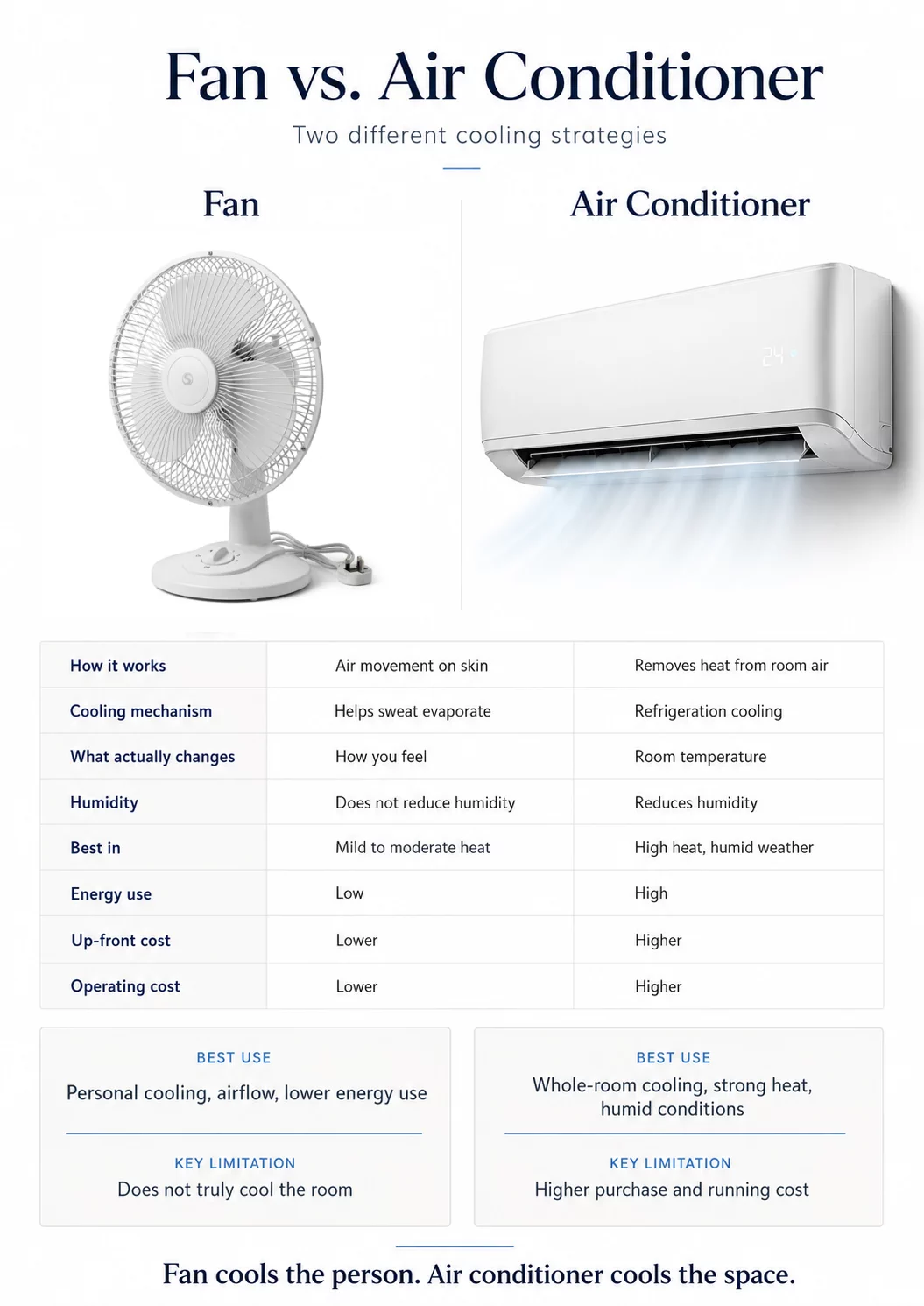
This is where a lot of confusion starts. A fan can make you feel much better in a warm room, but it does that by moving air across your skin. An air conditioner changes the room itself. It lowers the air temperature and usually helps with humidity too.
So the real question is not "Which one is better?" It is more like: what kind of heat are you dealing with, what kind of comfort do you want, and how much do running cost and setup matter to you?

The short version
A fan is often the first thing people try because it is easy. You place it in the room, turn it on, and you feel a difference almost right away. That is enough in a lot of situations. If the room is only mildly warm, a fan may be all you need.
Air conditioning is a different level of cooling. It is not just about airflow. It actually removes heat from the indoor air. That matters much more when the room stays hot for hours, when the heat is heavy and sticky, or when sleeping and working become difficult even with a fan running.
A fan is quick, flexible, and relatively inexpensive to run. It works well for personal comfort, everyday airflow, and rooms where the heat is annoying but not overwhelming.
AC is for when the room itself needs to cool down. It is much better at handling stronger heat, warmer nights, and humid conditions that make a fan feel less effective.
Fans cost less to buy and use, but they do not truly cool the space. AC gives more control and stronger results, but the purchase, installation, and running cost are all higher.
A practical way to think about it
If the room gets stuffy and you mostly want air movement, a fan is often the right place to begin. That is especially true in bedrooms, desks, home offices, and living rooms where you want comfort without much setup.
If the room gets genuinely hot and stays hot, the answer shifts. A fan may still help, but now it is helping you tolerate the heat rather than fixing the room. That is usually where AC starts to make more sense.
Humidity changes the picture too. On a dry warm day, a fan can feel surprisingly effective. On a humid day, the same fan can feel a lot less impressive because the room still feels heavy. That is one of the biggest reasons people move from "fan is enough" to "I need air conditioning."
Is the room just warm, or is it actually hot for long stretches?
Do you mostly want airflow on you, or cooler air in the room?
Is humidity part of the problem?
Do you care most about lower running cost?
Will this be used for sleep, work, or all-day comfort?
Visual comparison
This graphic is worth keeping large because the text matters. It is not just decoration. It shows the core difference very clearly: a fan mainly changes comfort on the body, while an air conditioner changes the room and handles humidity much better.
When a fan makes sense
A fan usually makes sense when you want a lower-cost way to feel better in mild to moderate heat. It is great for bedrooms that need a bit more air movement, for desks and offices, for evenings when the room is warm but not unbearable, and for people who simply do not want the cost or setup of AC.
Fans also work well as part of a broader setup. Some people use one fan in a bedroom and another at a desk. Some use a ceiling fan to keep air moving through a room. Some combine a fan with open windows when the outside air is cooler.
Lower running cost, easy setup, personal airflow, portable use, and flexible placement.
Strong heat, sticky humidity, and rooms that stay hot even when air is moving.
It cools the room itself, handles humid weather better, and gives more control when comfort really matters.
Higher purchase cost, higher energy use, more equipment, and in many cases installation or maintenance to think about.
When AC makes more sense
AC starts to make more sense when the temperature is high enough that airflow alone stops being satisfying. It also helps when the room traps heat, when outside conditions are humid, or when better sleep depends on the room actually being cooler.
If the room feels oppressive rather than just warm, that is often the dividing line. A fan still has value, but AC is doing the heavier job in that situation.
Cost and energy
Fans usually win on energy use and running cost by a wide margin. That is one reason they are such a common first choice. If you can stay comfortable with a fan, the ongoing cost is usually much easier to live with.
AC asks more from the budget, both up front and over time. That does not make it the wrong choice. It just means you are paying for a bigger job. A room fan and an air conditioner are not really interchangeable purchases. They overlap, but they solve heat in different ways.
A fan is usually much easier to buy without much planning. Air conditioning is more of a commitment, especially if installation is involved.
Fans are generally far cheaper to run. If you are cost-sensitive and the heat is manageable, that alone can settle the decision.
Some people get the best result by combining both. AC handles the room, while a fan helps move the cooled air and may let you run the AC less aggressively.
What people often get wrong
That sounds obvious once said plainly, but it is the mistake behind a lot of bad expectations. A fan is not failing when the room stays warm. It was never meant to cool the room in the same way AC does. It is meant to improve how the room feels to the person using it.
On the other side, AC is not just a "better fan." It does more, but it also costs more and brings different trade-offs. The right choice depends on what kind of problem you are actually trying to solve.
FAQ